Dhar - Pakad

Dhar - Pakad

Designing a Board Game to Teach Sustainability Through Play

Designing a Board Game to Teach Sustainability Through Play

00

Duration

4 months

Skills

Design Research
Game Design
Visual Design
Illustration

Collaborator

Apoorv Anurag

Outcome

Board Game
Published Paper in India HCI 2024

01

Introduction

Introduction

Project Overview

Sustainability and civic responsibility are often introduced through classroom instruction, but concepts such as waste segregation, sanitation, and environmental stewardship are difficult to internalize without practical application. While national initiatives like the Swachh Bharat Mission promote cleaner communities, there remains a gap between awareness and everyday action, particularly among younger students.

The primary objective was to design a board game that transforms civic education into an interactive and memorable experience. Rather than testing factual knowledge, the game encourages players to recognize, discuss, and reflect on sustainable behaviours through strategic role-play.

The idea of a guardian spirit that protects the cultural, ecological, and social fabric of a community is deeply rooted across the Konkan region. Numerous accounts describe encounters with colossal anthropomorphic beings that share strikingly similar characteristics despite originating from different villages and communities. These entities are known by various names including Rakhandar, Rakhnau, Naas, Rakhno, Devchar, and Daivata with each name reflecting regional dialects, local traditions, and cultural interpretations. While the stories may differ in detail, they collectively point to a shared belief in a powerful presence that watches over both people and place.

The Problem

Environmental education often emphasizes memorization over participation. Students may understand sustainability in theory, yet have limited opportunities to apply these concepts in meaningful, real-world contexts.


Traditional teaching methods rarely simulate the everyday decisions that collectively shape cleaner and more sustainable communities.

Existing educational games also tend to be designed around Western contexts or focus on abstract environmental systems, making them less relatable for Indian students. We identified an opportunity to create a culturally grounded learning experience that reflects familiar settings, governance structures, and social behaviours while encouraging active discussion and collaborative problem-solving.

Objectives

Promote awareness of cleanliness, sanitation, and sustainable everyday practices.

Encourage critical thinking through decision-making instead of passive learning.

Leverage role-playing to create empathy for different civic responsibilities.

Stimulate discussion between players around environmental and social issues.

Localize the experience through an Indian village setting, familiar characters, and culturally relevant scenarios.

02

Research

Research

The research phase sought to understand how sustainability education could move beyond awareness campaigns and become an engaging, memorable experience for children. Rather than beginning with mechanics, the project first examined environmental education, behavioural change, educational game design, and the everyday experiences that shaped people's understanding of cleanliness and civic responsibility. These findings later informed the narrative, mechanics, and overall structure of the board game.

The idea of a guardian spirit that protects the cultural, ecological, and social fabric of a community is deeply rooted across the Konkan region. Numerous accounts describe encounters with colossal anthropomorphic beings that share strikingly similar characteristics despite originating from different villages and communities. These entities are known by various names including Rakhandar, Rakhnau, Naas, Rakhno, Devchar, and Daivata with each name reflecting regional dialects, local traditions, and cultural interpretations. While the stories may differ in detail, they collectively point to a shared belief in a powerful presence that watches over both people and place.

Understanding the Problem

The motivation behind Dhar Pakad emerged from observing everyday environmental negligence that had gradually become normalized from littering in public transport and garbage dumping near homes to pollution around popular tourist destinations. These recurring experiences highlighted a gap between environmental awareness and responsible behaviour, suggesting that sustainable habits need to be cultivated much earlier in life.

The idea of a guardian spirit that protects the cultural, ecological, and social fabric of a community is deeply rooted across the Konkan region. Numerous accounts describe encounters with colossal anthropomorphic beings that share strikingly similar characteristics despite originating from different villages and communities. These entities are known by various names including Rakhandar, Rakhnau, Naas, Rakhno, Devchar, and Daivata with each name reflecting regional dialects, local traditions, and cultural interpretations. While the stories may differ in detail, they collectively point to a shared belief in a powerful presence that watches over both people and place.

Design Insight

Behavioural change should be introduced through engaging experiences rather than punishment or instruction.

Existing Sustainability Initiatives

Research explored both international and national sustainability efforts, including the United Nations Sustainable Development Goals (SDG 6 & SDG 12) and India's Swachh Bharat Mission. While these initiatives have significantly increased public awareness through Information, Education and Communication (IEC) campaigns, they primarily rely on posters, advertisements, and public outreach. The opportunity was to explore whether play could become another medium for environmental education.

Design Insight

Transform passive awareness into active participation through gameplay.

Why Games?

Literature surrounding educational games consistently suggests that players retain knowledge more effectively when they actively participate rather than simply receive information. UNESCO similarly advocates embedding sustainability within integrated learning experiences instead of teaching it as an isolated topic. Role-playing, collaboration, competition, and decision-making all contribute to deeper understanding and longer-term retention.

Design Insight

Players should learn sustainability by making decisions, negotiating outcomes, and experiencing consequences.

Excerpts from interviews

To ground the research in lived experiences, semi-structured interviews were conducted with children, parents, and young adults to understand everyday attitudes toward cleanliness, waste disposal, and environmental responsibility. These conversations uncovered common behaviours, motivations, and misconceptions, providing qualitative insights that shaped the game's narrative, mechanics, and localized interactions.

The idea of a guardian spirit that protects the cultural, ecological, and social fabric of a community is deeply rooted across the Konkan region. Numerous accounts describe encounters with colossal anthropomorphic beings that share strikingly similar characteristics despite originating from different villages and communities. These entities are known by various names including Rakhandar, Rakhnau, Naas, Rakhno, Devchar, and Daivata with each name reflecting regional dialects, local traditions, and cultural interpretations. While the stories may differ in detail, they collectively point to a shared belief in a powerful presence that watches over both people and place.

"While I was travelling in a bus once, and somebody spat Paan on me"

"Someone threw fish curry all over my shirt while travelling on a train"

"An empty plot beside my house has been turned into a spot for garbage dump"

Learning from Existing Media

Several games and media informed different aspects of the design

The idea of a guardian spirit that protects the cultural, ecological, and social fabric of a community is deeply rooted across the Konkan region. Numerous accounts describe encounters with colossal anthropomorphic beings that share strikingly similar characteristics despite originating from different villages and communities. These entities are known by various names including Rakhandar, Rakhnau, Naas, Rakhno, Devchar, and Daivata with each name reflecting regional dialects, local traditions, and cultural interpretations. While the stories may differ in detail, they collectively point to a shared belief in a powerful presence that watches over both people and place.

Panchayat (TVF)

Narrative framing, rural governance, humour, and the surprise inspection scenario

Civic Sense

Localized environmental awareness

Hide the Corpse

Hidden information and player tension

Betrayal at House on the Hill

Exploration and emergent gameplay

Designing for Regional Relevance

One of the strongest findings during research was that educational experiences become more memorable when they feel culturally familiar. Instead of generic environmental scenarios, the game incorporates local language, familiar village settings, culturally significant objects such as lota, paan, and charpai, and everyday activities including distributing prasad and purchasing local goods. Even character expressions and dialogue were designed around recognizable Indian social interactions, allowing sustainability to feel like part of daily life rather than an abstract concept.

The idea of a guardian spirit that protects the cultural, ecological, and social fabric of a community is deeply rooted across the Konkan region. Numerous accounts describe encounters with colossal anthropomorphic beings that share strikingly similar characteristics despite originating from different villages and communities. These entities are known by various names including Rakhandar, Rakhnau, Naas, Rakhno, Devchar, and Daivata with each name reflecting regional dialects, local traditions, and cultural interpretations. While the stories may differ in detail, they collectively point to a shared belief in a powerful presence that watches over both people and place.

Design Insight

Players should recognise themselves and their communities within the game world.

03
Design Strategy

Design Strategy

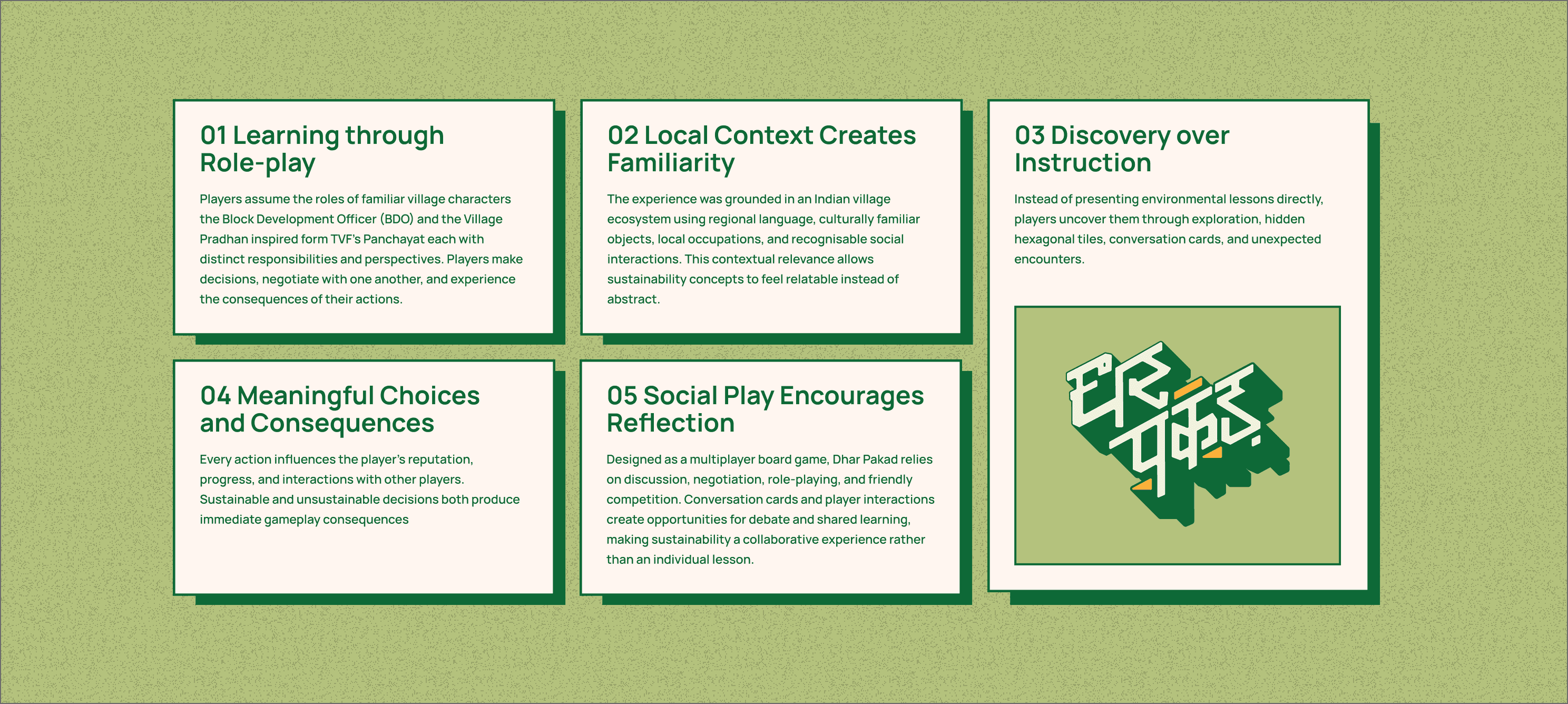
Research revealed that children learn most effectively when they actively participate rather than passively receive information. The goal was to embed sustainability within an engaging social experience where environmental choices naturally emerged through play.


The strategy revolved around five core design principles that informed the narrative, mechanics, visual language, and player interactions throughout the experience.

The idea of a guardian spirit that protects the cultural, ecological, and social fabric of a community is deeply rooted across the Konkan region. Numerous accounts describe encounters with colossal anthropomorphic beings that share strikingly similar characteristics despite originating from different villages and communities. These entities are known by various names including Rakhandar, Rakhnau, Naas, Rakhno, Devchar, and Daivata with each name reflecting regional dialects, local traditions, and cultural interpretations. While the stories may differ in detail, they collectively point to a shared belief in a powerful presence that watches over both people and place.

04

Prototypes and Evaluation

Prototypes and Evaluation

Prototypes

The project began with a series of low-fidelity prototypes focused on validating the game's core systems before investing in visual polish. Early iterations explored board layout, movement mechanics, hidden information, role asymmetry, and point progression using simple printed components.

These prototypes established the foundation of the gameplay while allowing mechanics to be rapidly modified between sessions. By intentionally keeping the prototype lightweight, design decisions could be evaluated based on player behaviour rather than aesthetics.

The idea of a guardian spirit that protects the cultural, ecological, and social fabric of a community is deeply rooted across the Konkan region. Numerous accounts describe encounters with colossal anthropomorphic beings that share strikingly similar characteristics despite originating from different villages and communities. These entities are known by various names including Rakhandar, Rakhnau, Naas, Rakhno, Devchar, and Daivata with each name reflecting regional dialects, local traditions, and cultural interpretations. While the stories may differ in detail, they collectively point to a shared belief in a powerful presence that watches over both people and place.

Prototype 1

Prototype 2

Prototype 3

Playtesting

To evaluate both gameplay balance and learning outcomes, the game was tested across three major iterations across two groups

The idea of a guardian spirit that protects the cultural, ecological, and social fabric of a community is deeply rooted across the Konkan region. Numerous accounts describe encounters with colossal anthropomorphic beings that share strikingly similar characteristics despite originating from different villages and communities. These entities are known by various names including Rakhandar, Rakhnau, Naas, Rakhno, Devchar, and Daivata with each name reflecting regional dialects, local traditions, and cultural interpretations. While the stories may differ in detail, they collectively point to a shared belief in a powerful presence that watches over both people and place.

Adult Testing: 7 gameplay sessions with engineers, interaction designers, and board game enthusiasts (21–29 years).

Student Testing: 6 gameplay sessions with students from Grades 3–10 (9–16 years).

Playtest 1

The first prototype focused on validating the core movement system, hidden activity chips, and asymmetric player roles.

The idea of a guardian spirit that protects the cultural, ecological, and social fabric of a community is deeply rooted across the Konkan region. Numerous accounts describe encounters with colossal anthropomorphic beings that share strikingly similar characteristics despite originating from different villages and communities. These entities are known by various names including Rakhandar, Rakhnau, Naas, Rakhno, Devchar, and Daivata with each name reflecting regional dialects, local traditions, and cultural interpretations. While the stories may differ in detail, they collectively point to a shared belief in a powerful presence that watches over both people and place.

Participants

2

Rounds

5

Observations

The Pradhan consistently held a strategic advantage due to unrestricted movement.

Blind spots on the board reduced player interactions.

Different penalty values made scoring unnecessarily complex.

Design Iterations

Restricted the Pradhan to directional movement, improving balance.

Reworked the board layout by introducing obstacles and eliminating blind spots.

Standardized penalty values across all activity chips to simplify scoring and improve fairness.

Playtest 2

The second iteration evaluated whether the revised mechanics supported the intended narrative and encouraged interaction between players.

The idea of a guardian spirit that protects the cultural, ecological, and social fabric of a community is deeply rooted across the Konkan region. Numerous accounts describe encounters with colossal anthropomorphic beings that share strikingly similar characteristics despite originating from different villages and communities. These entities are known by various names including Rakhandar, Rakhnau, Naas, Rakhno, Devchar, and Daivata with each name reflecting regional dialects, local traditions, and cultural interpretations. While the stories may differ in detail, they collectively point to a shared belief in a powerful presence that watches over both people and place.

Participants

2

Rounds

2

Observations

Players rarely used encounter mechanics.

Certain movement rules felt unintuitive.

Several mechanics conflicted with the narrative roles of the characters.

Design Iterations

Introduced Conversation Cards to transform encounters into strategic dialogue.

Simplified movement rules, making navigation more intuitive.

Restricted tower access exclusively to the BDO, reinforcing the narrative of official inspection and surveillance.

Playtest 3

The final round focused on educational impact, replayability, and long-term engagement with the game's sustainability objectives.

The idea of a guardian spirit that protects the cultural, ecological, and social fabric of a community is deeply rooted across the Konkan region. Numerous accounts describe encounters with colossal anthropomorphic beings that share strikingly similar characteristics despite originating from different villages and communities. These entities are known by various names including Rakhandar, Rakhnau, Naas, Rakhno, Devchar, and Daivata with each name reflecting regional dialects, local traditions, and cultural interpretations. While the stories may differ in detail, they collectively point to a shared belief in a powerful presence that watches over both people and place.

Participants

10 (Students)

Rounds

6

Observations

Players quickly identified good and bad activity chips through colour coding instead of reading the activities.

Gameplay became predictable after several rounds.

Older participants desired greater strategic depth.

Children particularly enjoyed role-playing and the dialogue-driven encounters.

Design Iterations

Removed visual indicators that revealed chip outcomes.

Added Power-ups and Debuffs to increase variability between matches.

Introduced Panic Tokens, creating high-risk conversation encounters and encouraging strategic decision-making.

Expanded the activity library and introduced a Sustainability Guidelines Sheet, prompting players to actively discuss whether behaviours were environmentally responsible instead of relying on visual cues.

Educational Outcomes

Beyond gameplay improvements, the final playtests demonstrated the game's effectiveness as a learning tool. Pre- and post-play discussions revealed increased awareness of sustainable practices such as composting, reducing plastic waste, and responsible resource management. Participants frequently debated environmental decisions during gameplay, while parents reported that children continued discussing the concepts after returning home.

These observations suggested that embedding sustainability within strategic play encouraged stronger engagement and longer information retention than traditional instructional approaches, validating the project's core design objective.

The idea of a guardian spirit that protects the cultural, ecological, and social fabric of a community is deeply rooted across the Konkan region. Numerous accounts describe encounters with colossal anthropomorphic beings that share strikingly similar characteristics despite originating from different villages and communities. These entities are known by various names including Rakhandar, Rakhnau, Naas, Rakhno, Devchar, and Daivata with each name reflecting regional dialects, local traditions, and cultural interpretations. While the stories may differ in detail, they collectively point to a shared belief in a powerful presence that watches over both people and place.

05

Visual Design

Visual Design

The visual identity of Dhar Pakad was designed to make sustainability approachable, playful, and culturally familiar. Rather than adopting an overly educational aesthetic, the game embraces a vibrant village setting inspired by everyday life in India.

The idea of a guardian spirit that protects the cultural, ecological, and social fabric of a community is deeply rooted across the Konkan region. Numerous accounts describe encounters with colossal anthropomorphic beings that share strikingly similar characteristics despite originating from different villages and communities. These entities are known by various names including Rakhandar, Rakhnau, Naas, Rakhno, Devchar, and Daivata with each name reflecting regional dialects, local traditions, and cultural interpretations. While the stories may differ in detail, they collectively point to a shared belief in a powerful presence that watches over both people and place.

Character Design

The two playable characters were designed to communicate their roles at a glance.

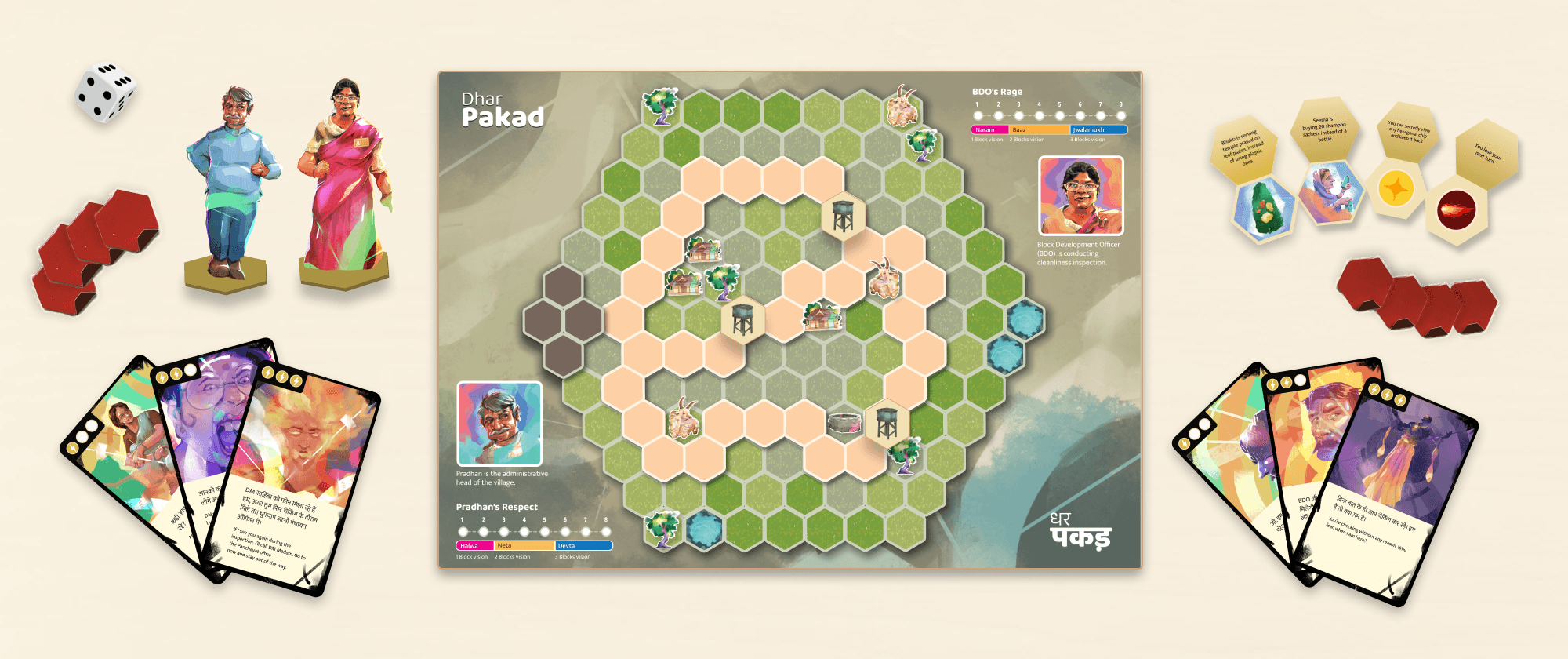
The Block Development Officer (BDO) uses a clean, official appearance that immediately conveys authority and accountability. In contrast, the Village Pradhan adopts a more relaxed, approachable visual language that reflects familiarity with the local community. This visual contrast reinforces the asymmetrical relationship between both players before gameplay even begins.

The idea of a guardian spirit that protects the cultural, ecological, and social fabric of a community is deeply rooted across the Konkan region. Numerous accounts describe encounters with colossal anthropomorphic beings that share strikingly similar characteristics despite originating from different villages and communities. These entities are known by various names including Rakhandar, Rakhnau, Naas, Rakhno, Devchar, and Daivata with each name reflecting regional dialects, local traditions, and cultural interpretations. While the stories may differ in detail, they collectively point to a shared belief in a powerful presence that watches over both people and place.

Visual Identity

The visual identity begins with the game's title, which was designed simultaneously in English and Devanagari to celebrate its Indian setting while remaining accessible to a wider audience. The logo adopts an isometric construction inspired directly by the hexagonal tiles that define the board's gameplay. Angular forms and geometric proportions mirror the game's spatial mechanics, creating a strong connection between the identity and the physical components. A natural green palette reflects themes of sustainability and environmental stewardship, while warm yellow accents introduce energy and playfulness.

The idea of a guardian spirit that protects the cultural, ecological, and social fabric of a community is deeply rooted across the Konkan region. Numerous accounts describe encounters with colossal anthropomorphic beings that share strikingly similar characteristics despite originating from different villages and communities. These entities are known by various names including Rakhandar, Rakhnau, Naas, Rakhno, Devchar, and Daivata with each name reflecting regional dialects, local traditions, and cultural interpretations. While the stories may differ in detail, they collectively point to a shared belief in a powerful presence that watches over both people and place.

Typography

Typography was selected to balance approachability with readability across a broad age group. Baloo 2 was chosen for both English and Devanagari because of its rounded forms, generous spacing, and playful personality. Its friendly appearance complements the game's humorous tone while maintaining excellent legibility for younger players. Supporting text follows a simple hierarchy with large headings, concise body copy, and bilingual content throughout the game components. This bilingual approach allows players from different linguistic backgrounds to engage with the game naturally while reinforcing its cultural authenticity.

The idea of a guardian spirit that protects the cultural, ecological, and social fabric of a community is deeply rooted across the Konkan region. Numerous accounts describe encounters with colossal anthropomorphic beings that share strikingly similar characteristics despite originating from different villages and communities. These entities are known by various names including Rakhandar, Rakhnau, Naas, Rakhno, Devchar, and Daivata with each name reflecting regional dialects, local traditions, and cultural interpretations. While the stories may differ in detail, they collectively point to a shared belief in a powerful presence that watches over both people and place.

06

Gameplay Design

Gameplay Design

The gameplay revolves around exploring a shared village map, uncovering hidden activities, and determining whether each represents responsible or irresponsible environmental behaviour. Every discovery affects the balance between the Pradhan's respect and the BDO's rage, creating a constant push-and-pull throughout the match.

The idea of a guardian spirit that protects the cultural, ecological, and social fabric of a community is deeply rooted across the Konkan region. Numerous accounts describe encounters with colossal anthropomorphic beings that share strikingly similar characteristics despite originating from different villages and communities. These entities are known by various names including Rakhandar, Rakhnau, Naas, Rakhno, Devchar, and Daivata with each name reflecting regional dialects, local traditions, and cultural interpretations. While the stories may differ in detail, they collectively point to a shared belief in a powerful presence that watches over both people and place.

Core Mechanics

Hidden Information

Activities remain concealed until discovered. Players cannot immediately identify whether a location contains positive or negative behaviour, encouraging exploration rather than memorization.

The idea of a guardian spirit that protects the cultural, ecological, and social fabric of a community is deeply rooted across the Konkan region. Numerous accounts describe encounters with colossal anthropomorphic beings that share strikingly similar characteristics despite originating from different villages and communities. These entities are known by various names including Rakhandar, Rakhnau, Naas, Rakhno, Devchar, and Daivata with each name reflecting regional dialects, local traditions, and cultural interpretations. While the stories may differ in detail, they collectively point to a shared belief in a powerful presence that watches over both people and place.

Asymmetrical Movement

Each role moves differently across the map. The Pradhan's familiarity with the village allows greater movement flexibility, while the BDO follows roads, reflecting an outsider navigating unfamiliar terrain.

The idea of a guardian spirit that protects the cultural, ecological, and social fabric of a community is deeply rooted across the Konkan region. Numerous accounts describe encounters with colossal anthropomorphic beings that share strikingly similar characteristics despite originating from different villages and communities. These entities are known by various names including Rakhandar, Rakhnau, Naas, Rakhno, Devchar, and Daivata with each name reflecting regional dialects, local traditions, and cultural interpretations. While the stories may differ in detail, they collectively point to a shared belief in a powerful presence that watches over both people and place.

Vision System

Both players have limited visibility. Respect and Rage directly influence how much of the surrounding village becomes visible, creating a dynamic relationship between player performance and available information.

The idea of a guardian spirit that protects the cultural, ecological, and social fabric of a community is deeply rooted across the Konkan region. Numerous accounts describe encounters with colossal anthropomorphic beings that share strikingly similar characteristics despite originating from different villages and communities. These entities are known by various names including Rakhandar, Rakhnau, Naas, Rakhno, Devchar, and Daivata with each name reflecting regional dialects, local traditions, and cultural interpretations. While the stories may differ in detail, they collectively point to a shared belief in a powerful presence that watches over both people and place.

Conversation Cards

Instead of relying purely on chance, players periodically engage in conversations where dialogue cards determine outcomes. These interactions introduce bluffing, humour, and role-play while balancing gameplay through social mechanics rather than numerical advantages.

The idea of a guardian spirit that protects the cultural, ecological, and social fabric of a community is deeply rooted across the Konkan region. Numerous accounts describe encounters with colossal anthropomorphic beings that share strikingly similar characteristics despite originating from different villages and communities. These entities are known by various names including Rakhandar, Rakhnau, Naas, Rakhno, Devchar, and Daivata with each name reflecting regional dialects, local traditions, and cultural interpretations. While the stories may differ in detail, they collectively point to a shared belief in a powerful presence that watches over both people and place.

Power-ups & Debuffs

Later prototypes introduced temporary abilities hidden within activity chips. These increase unpredictability, reduce repetitive strategies, and encourage players to continuously adapt.

The idea of a guardian spirit that protects the cultural, ecological, and social fabric of a community is deeply rooted across the Konkan region. Numerous accounts describe encounters with colossal anthropomorphic beings that share strikingly similar characteristics despite originating from different villages and communities. These entities are known by various names including Rakhandar, Rakhnau, Naas, Rakhno, Devchar, and Daivata with each name reflecting regional dialects, local traditions, and cultural interpretations. While the stories may differ in detail, they collectively point to a shared belief in a powerful presence that watches over both people and place.

Asymmetrical Movement

Each role moves differently across the map. The Pradhan's familiarity with the village allows greater movement flexibility, while the BDO follows roads, reflecting an outsider navigating unfamiliar terrain.

The idea of a guardian spirit that protects the cultural, ecological, and social fabric of a community is deeply rooted across the Konkan region. Numerous accounts describe encounters with colossal anthropomorphic beings that share strikingly similar characteristics despite originating from different villages and communities. These entities are known by various names including Rakhandar, Rakhnau, Naas, Rakhno, Devchar, and Daivata with each name reflecting regional dialects, local traditions, and cultural interpretations. While the stories may differ in detail, they collectively point to a shared belief in a powerful presence that watches over both people and place.

Vision System

Both players have limited visibility. Respect and Rage directly influence how much of the surrounding village becomes visible, creating a dynamic relationship between player performance and available information.

The idea of a guardian spirit that protects the cultural, ecological, and social fabric of a community is deeply rooted across the Konkan region. Numerous accounts describe encounters with colossal anthropomorphic beings that share strikingly similar characteristics despite originating from different villages and communities. These entities are known by various names including Rakhandar, Rakhnau, Naas, Rakhno, Devchar, and Daivata with each name reflecting regional dialects, local traditions, and cultural interpretations. While the stories may differ in detail, they collectively point to a shared belief in a powerful presence that watches over both people and place.

Conversation Cards

Instead of relying purely on chance, players periodically engage in conversations where dialogue cards determine outcomes. These interactions introduce bluffing, humour, and role-play while balancing gameplay through social mechanics rather than numerical advantages.

The idea of a guardian spirit that protects the cultural, ecological, and social fabric of a community is deeply rooted across the Konkan region. Numerous accounts describe encounters with colossal anthropomorphic beings that share strikingly similar characteristics despite originating from different villages and communities. These entities are known by various names including Rakhandar, Rakhnau, Naas, Rakhno, Devchar, and Daivata with each name reflecting regional dialects, local traditions, and cultural interpretations. While the stories may differ in detail, they collectively point to a shared belief in a powerful presence that watches over both people and place.

Balancing the Game

Rather than aiming for perfect symmetry, the mechanics were continuously rebalanced through seven rounds of prototyping. Changes to movement, scoring, hidden information, and conversation mechanics ensured neither role consistently dominated while preserving the educational objective of the game.

The idea of a guardian spirit that protects the cultural, ecological, and social fabric of a community is deeply rooted across the Konkan region. Numerous accounts describe encounters with colossal anthropomorphic beings that share strikingly similar characteristics despite originating from different villages and communities. These entities are known by various names including Rakhandar, Rakhnau, Naas, Rakhno, Devchar, and Daivata with each name reflecting regional dialects, local traditions, and cultural interpretations. While the stories may differ in detail, they collectively point to a shared belief in a powerful presence that watches over both people and place.

Onboarding

To reduce the learning curve, I designed a short illustrated comic that introduces the game's premise, characters, and objectives before players begin. Instead of presenting the rules as a dense instruction booklet, the onboarding places players directly into the narrative, where the Block Development Officer (BDO) arrives for a surprise Swachh Bharat inspection while the Pradhan attempts to preserve the village's reputation.


The comic establishes the motivations of both playable characters, explains the stakes of the inspection, and naturally introduces the core gameplay loop before the first turn is taken. Dialogue, visual sequencing, and exaggerated character expressions were used to make the onboarding engaging and memorable, allowing players to understand why they are performing certain actions

The idea of a guardian spirit that protects the cultural, ecological, and social fabric of a community is deeply rooted across the Konkan region. Numerous accounts describe encounters with colossal anthropomorphic beings that share strikingly similar characteristics despite originating from different villages and communities. These entities are known by various names including Rakhandar, Rakhnau, Naas, Rakhno, Devchar, and Daivata with each name reflecting regional dialects, local traditions, and cultural interpretations. While the stories may differ in detail, they collectively point to a shared belief in a powerful presence that watches over both people and place.

07

Outcome

Outcome

Dhar-Pakad culminated in a fully realized educational board game that transforms environmental awareness into an engaging, competitive, and socially interactive experience. Through multiple rounds of prototyping and playtesting, the game evolved into a balanced system that combines strategic decision-making, role-playing, and storytelling to encourage discussions around cleanliness and sustainability.


Designed for children aged 9–16 years while remaining enjoyable for adults, the final game successfully bridges education and entertainment. Playtesting demonstrated improved awareness of sustainable practices, with participants actively discussing environmental issues during gameplay and recalling key concepts even after the sessions had ended. By grounding its mechanics in familiar village settings and everyday behaviours, Dhar-Pakad demonstrates how thoughtful game design can foster meaningful learning through play.

The idea of a guardian spirit that protects the cultural, ecological, and social fabric of a community is deeply rooted across the Konkan region. Numerous accounts describe encounters with colossal anthropomorphic beings that share strikingly similar characteristics despite originating from different villages and communities. These entities are known by various names including Rakhandar, Rakhnau, Naas, Rakhno, Devchar, and Daivata with each name reflecting regional dialects, local traditions, and cultural interpretations. While the stories may differ in detail, they collectively point to a shared belief in a powerful presence that watches over both people and place.

08

Publication

Publication

The research and design process behind Dhar-Pakad culminated in a peer-reviewed publication as a book chapter in the Human-Computer Interaction. Design and Research proceedings published by Springer. The chapter documents the project's research methodology, iterative design process, gameplay mechanics, and evaluation, demonstrating how board game design can be used as an effective medium for promoting environmental awareness and sustainable behaviour among young learners. The publication extends the project's impact beyond the classroom, contributing to the broader discourse on game-based learning, interaction design, and sustainability education.

The idea of a guardian spirit that protects the cultural, ecological, and social fabric of a community is deeply rooted across the Konkan region. Numerous accounts describe encounters with colossal anthropomorphic beings that share strikingly similar characteristics despite originating from different villages and communities. These entities are known by various names including Rakhandar, Rakhnau, Naas, Rakhno, Devchar, and Daivata with each name reflecting regional dialects, local traditions, and cultural interpretations. While the stories may differ in detail, they collectively point to a shared belief in a powerful presence that watches over both people and place.