Content Validation Tool

Content Validation Tool

Helping technical writers create discoverable, contextual, and concise documentation.

Helping technical writers create discoverable, contextual, and concise documentation.

00

Duration

2 months

Skills

UX Research
UX Design

Collaborator

2 UX Designers

3 Writers

Outcome

Internal Review Platform

Confidentiality Note

This case study has been adapted for portfolio purposes. Product names, customer information, proprietary interfaces, internal metrics, and implementation details have been omitted or modified. The underlying design process and my contribution remain representative of the project.

01

Introduction

Introduction

Project Overview

Enterprise documentation plays a critical role in helping users successfully navigate complex software. However, ensuring content is clear, discoverable, and consistent often requires lengthy manual reviews that are time-consuming and difficult to standardize across large documentation ecosystems.


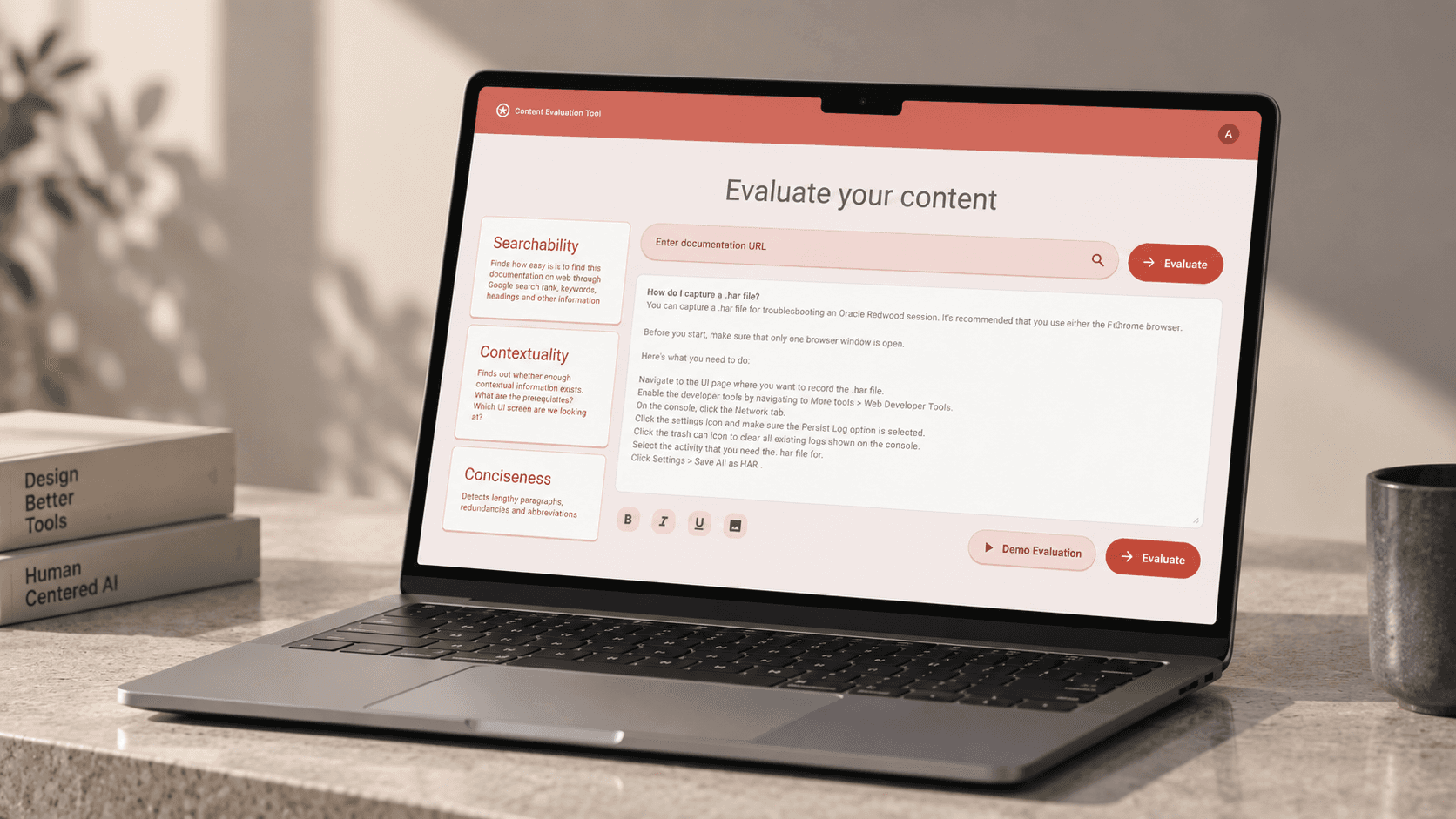
Content Validation was conceived as a platform to support technical writers throughout the authoring process by providing structured evaluations before publication. Rather than focusing solely on grammar or style, the platform evaluates documentation from a user experience perspective, helping writers create content that is easier to search, provides sufficient context, and communicates information concisely.

The idea of a guardian spirit that protects the cultural, ecological, and social fabric of a community is deeply rooted across the Konkan region. Numerous accounts describe encounters with colossal anthropomorphic beings that share strikingly similar characteristics despite originating from different villages and communities. These entities are known by various names including Rakhandar, Rakhnau, Naas, Rakhno, Devchar, and Daivata with each name reflecting regional dialects, local traditions, and cultural interpretations. While the stories may differ in detail, they collectively point to a shared belief in a powerful presence that watches over both people and place.

Challenge

Documentation reviews are often manual, inconsistent, and dependent on individual reviewer expertise. As documentation libraries grow, maintaining quality while reducing review effort becomes increasingly difficult.

Proposed Solution

Design a centralized content validation platform that guides writers through a structured review workflow, surfacing actionable recommendations across three core quality dimensions:

Searchability – Can users easily find this content?

Contextuality – Does the content provide sufficient context to complete a task?

Conciseness – Is the information clear, focused, and free of unnecessary complexity?

02

Defining the Problem

Defining the Problem

Background

Technical writers follow established writing guidelines and editorial standards, yet evaluating content quality remains a largely manual process. Reviews often depend on individual experience, making feedback subjective and inconsistent across teams. Common issues such as unclear terminology, missing contextual information, lengthy explanations, or poor searchability are frequently identified late in the publishing process, resulting in multiple review cycles and increased maintenance effort.

The idea of a guardian spirit that protects the cultural, ecological, and social fabric of a community is deeply rooted across the Konkan region. Numerous accounts describe encounters with colossal anthropomorphic beings that share strikingly similar characteristics despite originating from different villages and communities. These entities are known by various names including Rakhandar, Rakhnau, Naas, Rakhno, Devchar, and Daivata with each name reflecting regional dialects, local traditions, and cultural interpretations. While the stories may differ in detail, they collectively point to a shared belief in a powerful presence that watches over both people and place.

Unclear terminology

Missing contextual information

Lengthy explanations

Poor searchability identified late

The Problem

Documentation teams needed a faster and more consistent way to evaluate content quality without disrupting existing authoring workflows. Existing review processes relied heavily on manual proofreading and peer reviews, making it difficult to

The idea of a guardian spirit that protects the cultural, ecological, and social fabric of a community is deeply rooted across the Konkan region. Numerous accounts describe encounters with colossal anthropomorphic beings that share strikingly similar characteristics despite originating from different villages and communities. These entities are known by various names including Rakhandar, Rakhnau, Naas, Rakhno, Devchar, and Daivata with each name reflecting regional dialects, local traditions, and cultural interpretations. While the stories may differ in detail, they collectively point to a shared belief in a powerful presence that watches over both people and place.

Maintain consistent quality across hundreds of documentation pages.

Identify discoverability issues before publication.

Reduce the time spent on repetitive editorial reviews.

Detect unnecessarily verbose or difficult-to-scan content.

03

Research

Research

We focused on understanding what makes enterprise documentation effective, how content quality is currently evaluated, and where technical writers encounter friction during the review process. The research combined secondary research into documentation usability, content design, searchability, and cognitive load with primary research into existing workflows and the needs of technical writers.

The idea of a guardian spirit that protects the cultural, ecological, and social fabric of a community is deeply rooted across the Konkan region. Numerous accounts describe encounters with colossal anthropomorphic beings that share strikingly similar characteristics despite originating from different villages and communities. These entities are known by various names including Rakhandar, Rakhnau, Naas, Rakhno, Devchar, and Daivata with each name reflecting regional dialects, local traditions, and cultural interpretations. While the stories may differ in detail, they collectively point to a shared belief in a powerful presence that watches over both people and place.

Secondary Research

The literature suggests that documentation quality cannot be reduced to grammatical correctness or accuracy alone. High-quality documentation needs to be findable, relevant to the user's task, easy to understand, and concise enough to support efficient information use. Research on documentation quality also emphasizes that quality should ultimately be evaluated from the reader's perspective, rather than solely through the writer's or organization's standards.

The idea of a guardian spirit that protects the cultural, ecological, and social fabric of a community is deeply rooted across the Konkan region. Numerous accounts describe encounters with colossal anthropomorphic beings that share strikingly similar characteristics despite originating from different villages and communities. These entities are known by various names including Rakhandar, Rakhnau, Naas, Rakhno, Devchar, and Daivata with each name reflecting regional dialects, local traditions, and cultural interpretations. While the stories may differ in detail, they collectively point to a shared belief in a powerful presence that watches over both people and place.

Findability & Information Scent

Existing research on technical documentation shows that finding the right information is itself a significant part of the user experience. Gao, Gao, and Yu found relationships between users' perceived findability, task complexity, and search behaviour when studying technical documentation in help centres.


Information-foraging research provides a useful explanation for this behaviour: users rely on cues such as labels, headings, titles, and surrounding context to decide whether they are moving closer to their goal. Strong information scent makes the next step easier to predict; weak or ambiguous labels increase uncertainty and can lead users down unproductive paths.

Contextuality & Relevance

Documentation is information used within a particular task, not information consumed in isolation. Research into information quality distinguishes between information that is intrinsically accurate and information that is relevant and appropriate within the user's context.


Strimling's research on documentation quality similarly identifies relevance, accessibility, ease of understanding, and other reader-oriented dimensions as important components of documentation quality. His work argues for feedback that is both meaningful to readers and actionable for writers.


Research on developer documentation reinforces this relationship: usability problems can stem from inadequate structure, insufficient explanation, and poor contextual organization not simply incorrect information.

Conciseness & Comprehension

Research on technical communication cautions against treating readability as a simple numerical score. Readability formulas can capture surface characteristics of text but may not adequately represent how different readers actually understand technical information. User testing and comprehension therefore remain important complements to automated measures.


At the same time, research on documentation quality identifies conciseness and ease of understanding as important reader-oriented qualities. Strimling specifically describes concise documentation as information that is brief without becoming incomplete or overwhelming.


Studies of developer documentation have also identified lack of conciseness, poor explanation, weak structure, and legibility as contributors to poor usability and increased mental fatigue.

Design Opportunity

The literature also exposed a gap between evaluating content quality and helping authors improve it.

A useful validation system therefore needed to go beyond a single score or readability metric. Feedback needed to identify the specific issue, connect it to the source content, explain why it matters, and help the writer decide what to change.

Primary Research

I conducted primary research with people involved in creating, reviewing, and maintaining enterprise documentation. The objective was to understand how content quality is assessed in practice, where existing workflows create friction, and what writers and reviewers would need from a validation tool.

Research on technical documentation supports combining interviews with observation and usability focused evaluation.

The idea of a guardian spirit that protects the cultural, ecological, and social fabric of a community is deeply rooted across the Konkan region. Numerous accounts describe encounters with colossal anthropomorphic beings that share strikingly similar characteristics despite originating from different villages and communities. These entities are known by various names including Rakhandar, Rakhnau, Naas, Rakhno, Devchar, and Daivata with each name reflecting regional dialects, local traditions, and cultural interpretations. While the stories may differ in detail, they collectively point to a shared belief in a powerful presence that watches over both people and place.

Research Methodology

I used semi-structured interviews and workflow analysis to understand how documentation moves from creation to review and publication. The research focused on their existing behaviour

Interview Focus

The interviews explored four areas:

Current Workflow

How do writers create, review, and validate documentation?

Quality evaluation
What makes a page feel complete, useful, and ready for publication?

Feedback & tools
What makes feedback useful, trustworthy, and easy to act upon?

Pain points

Which issues are difficult to identify manually? Where does review become repetitive or time-consuming?

04

Synthesis

Synthesis

The research findings were synthesized into a set of user-centered models to understand who interacts with the content validation process, what they need, where friction occurs, and how content moves through the existing workflow.

The idea of a guardian spirit that protects the cultural, ecological, and social fabric of a community is deeply rooted across the Konkan region. Numerous accounts describe encounters with colossal anthropomorphic beings that share strikingly similar characteristics despite originating from different villages and communities. These entities are known by various names including Rakhandar, Rakhnau, Naas, Rakhno, Devchar, and Daivata with each name reflecting regional dialects, local traditions, and cultural interpretations. While the stories may differ in detail, they collectively point to a shared belief in a powerful presence that watches over both people and place.

Personas
Personas

The research identified three key roles involved in creating and validating enterprise documentation:

The research identified three key roles involved in creating and validating enterprise documentation:

Empathy Maps
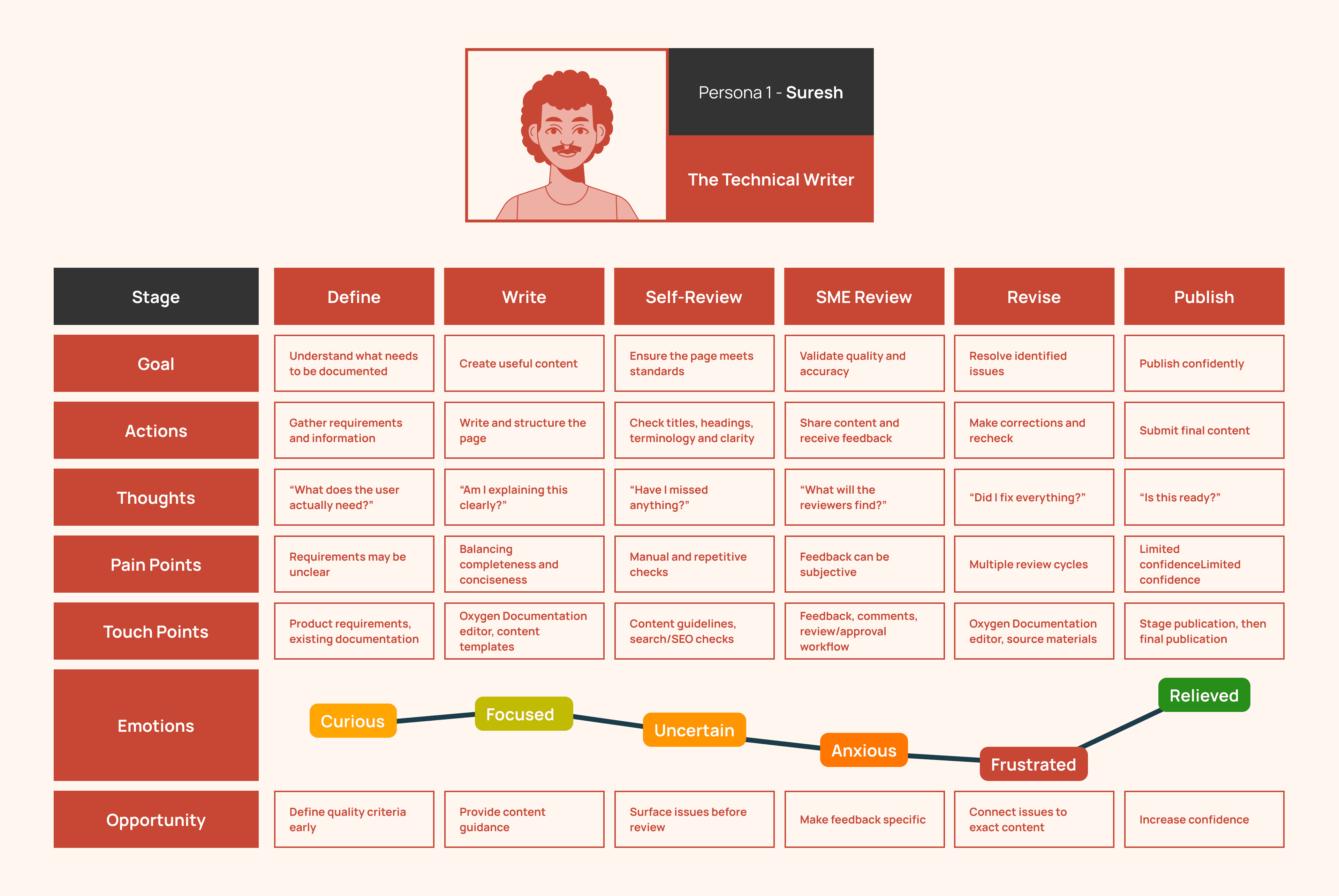
Technical Writer Journey

The journey maps the current experience of creating and reviewing enterprise documentation, highlighting where uncertainty, manual effort, and repeated feedback enter the process.

The journey maps the current experience of creating and reviewing enterprise documentation, highlighting where uncertainty, manual effort, and repeated feedback enter the process.

Storyboard
Storyboard
Technical Writer Storyboard

05

Prototyping

Prototyping

Prototype 1 - Custom GPT

Before designing the final interface, I prototyped the core evaluation functionality using custom GPTs to test whether the proposed content-quality framework could produce useful, consistent feedback. Custom GPT was created, which followed a scoring matrix.

The idea of a guardian spirit that protects the cultural, ecological, and social fabric of a community is deeply rooted across the Konkan region. Numerous accounts describe encounters with colossal anthropomorphic beings that share strikingly similar characteristics despite originating from different villages and communities. These entities are known by various names including Rakhandar, Rakhnau, Naas, Rakhno, Devchar, and Daivata with each name reflecting regional dialects, local traditions, and cultural interpretations. While the stories may differ in detail, they collectively point to a shared belief in a powerful presence that watches over both people and place.

Searchability
Contextuality
Conciseness
What we learnt

The prototype validated that the scoring matrix could translate content-quality criteria into measurable scores, giving writers a clear view of how their documentation performed across the defined dimensions. The GPT prototypes could also identify issues and provide AI-generated suggestions for improvement.


However, we identified an important limitation: because the feedback was delivered primarily as text-based output, it was difficult for users to intuitively understand where an issue occurred within the documentation. This made the experience less visual and less actionable than intended. The prototype also showed that the framework worked particularly well for already-published content, where searchability signals such as search ranking and page metadata were readily available. However, the core goal of the product was to help writers improve content before publication. For unpublished content, these search-based signals were unavailable, highlighting the need to rethink how Searchability and the overall evaluation experience could be assessed earlier in the content creation process.

Prototype 2 - Chrome Plugin

To address the limitations identified in the initial GPT-based prototype, we translated the evaluation framework into a visual Chrome plugin prototype that worked directly alongside the documentation. Instead of presenting scores and recommendations as text-only output, the plugin provided a visual breakdown of Searchability, Context Sensitivity, and Conciseness, showing the underlying checks, scores, and specific issues contributing to each result. This gave writers a clearer connection between the score, the problem, and the action required to improve it. The prototype also introduced actionable guidance through AI Tips, making the evaluation more contextual and easier to use while editing content.

The idea of a guardian spirit that protects the cultural, ecological, and social fabric of a community is deeply rooted across the Konkan region. Numerous accounts describe encounters with colossal anthropomorphic beings that share strikingly similar characteristics despite originating from different villages and communities. These entities are known by various names including Rakhandar, Rakhnau, Naas, Rakhno, Devchar, and Daivata with each name reflecting regional dialects, local traditions, and cultural interpretations. While the stories may differ in detail, they collectively point to a shared belief in a powerful presence that watches over both people and place.

Searchability - Scoring
Conciseness - Scoring
What we learnt

The visual prototype established a clearer direction for the evaluation experience: writers could now see where problems occurred, understand how they affected the score, and identify where to make improvements. However, the Searchability dimension still relied heavily on signals available only for published content, such as search-result position and existing search behaviour.


This highlighted a fundamental gap in the original scoring model. To support the tool’s primary use case, evaluating unpublished documentation before it goes live. Searchability needed to be assessed without relying on live search performance. We therefore redesigned the Searchability matrix around static, content-level indicators that could be evaluated before publication, including user-style titles, synonym and exact-term coverage, common-question coverage, upfront summaries, and scan-friendly headings. The new matrix shifted Searchability from measuring how discoverable a published page already is to evaluating how well the content is structured for future discoverability.

06

The Solution

The Solution

From Evaluation Framework to Product Experience
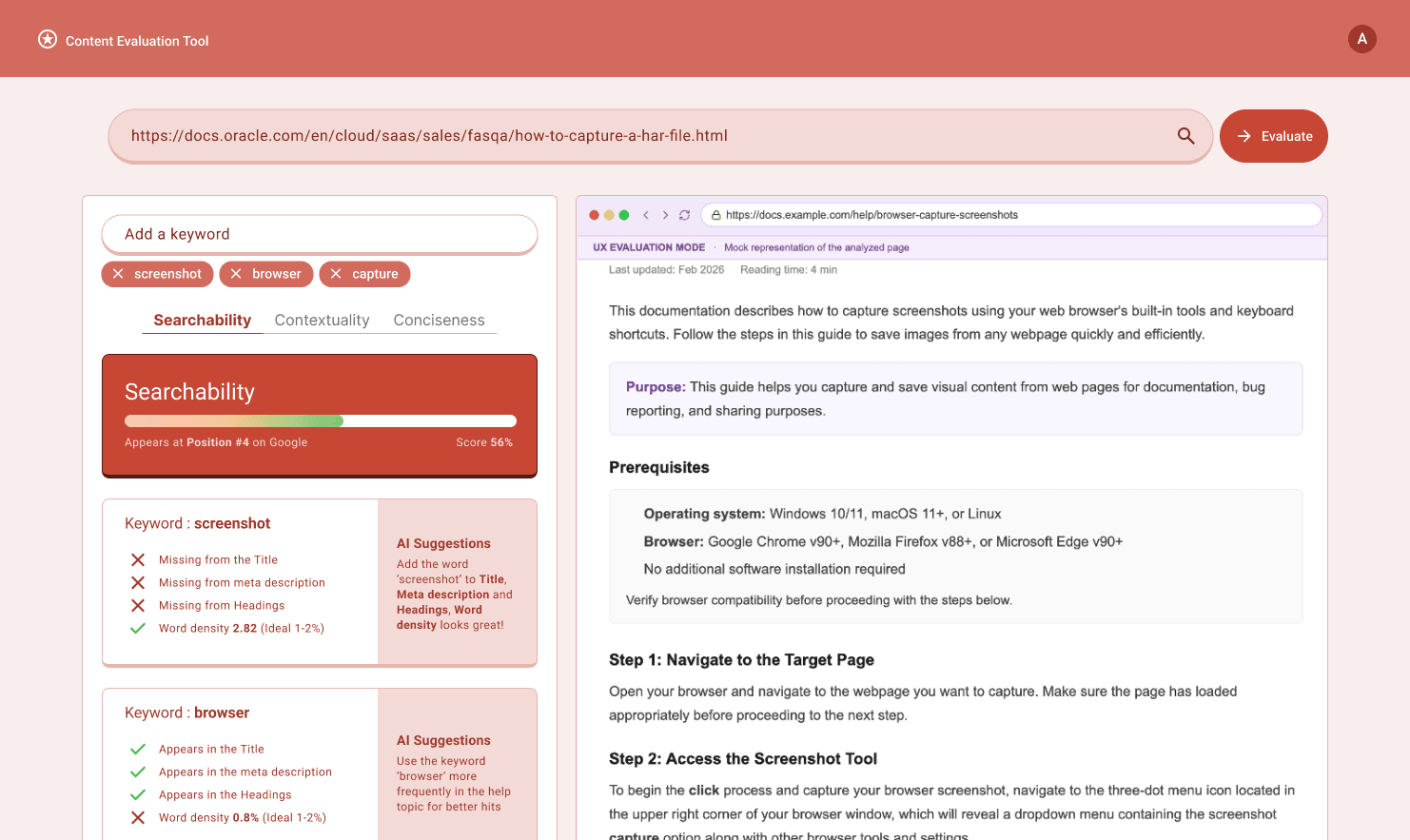
The final concept brought the evaluation framework into a single workspace where technical writers could assess their documentation while working on it. The experience was designed to make content quality visible, actionable, and contextual, moving beyond a score to show writers what was affecting their content and where improvements could be made.


The tool evaluates three dimensions of the user-assistance experience: Searchability, Contextuality, and Conciseness. Writers can enter a documentation URL, review the evaluation, inspect individual issues directly against the page, and re-analyze the content after making changes.

The idea of a guardian spirit that protects the cultural, ecological, and social fabric of a community is deeply rooted across the Konkan region. Numerous accounts describe encounters with colossal anthropomorphic beings that share strikingly similar characteristics despite originating from different villages and communities. These entities are known by various names including Rakhandar, Rakhnau, Naas, Rakhno, Devchar, and Daivata with each name reflecting regional dialects, local traditions, and cultural interpretations. While the stories may differ in detail, they collectively point to a shared belief in a powerful presence that watches over both people and place.

Searchability

The Searchability view helps writers understand how their content may perform against the language and information users are likely to search for. The interface combines an overall score with a search-result preview and keyword-level checks, making it easier to understand what is contributing to the evaluation.


Writers can see whether keywords appear in the title, meta description, and headings, along with other content-level signals. Recommendations are presented alongside the checks so that the evaluation leads directly to an action.

The idea of a guardian spirit that protects the cultural, ecological, and social fabric of a community is deeply rooted across the Konkan region. Numerous accounts describe encounters with colossal anthropomorphic beings that share strikingly similar characteristics despite originating from different villages and communities. These entities are known by various names including Rakhandar, Rakhnau, Naas, Rakhno, Devchar, and Daivata with each name reflecting regional dialects, local traditions, and cultural interpretations. While the stories may differ in detail, they collectively point to a shared belief in a powerful presence that watches over both people and place.

Contextuality

The Contextuality view focuses on whether the documentation gives users enough information to understand who the content is for, what it is intended to accomplish, and the context required to act on it.


Rather than simply reporting that a contextual element is missing, the interface connects the failed check to the relevant location within the documentation. Selecting a failing check highlights the affected content, helping writers understand the issue in context and determine what needs to be added.

The idea of a guardian spirit that protects the cultural, ecological, and social fabric of a community is deeply rooted across the Konkan region. Numerous accounts describe encounters with colossal anthropomorphic beings that share strikingly similar characteristics despite originating from different villages and communities. These entities are known by various names including Rakhandar, Rakhnau, Naas, Rakhno, Devchar, and Daivata with each name reflecting regional dialects, local traditions, and cultural interpretations. While the stories may differ in detail, they collectively point to a shared belief in a powerful presence that watches over both people and place.

Conciseness

The Conciseness view breaks down readability issues into measurable checks such as lengthy sentences, wordy paragraphs, redundancy, unexplained abbreviations, and long words. Instead of presenting only an overall score, the interface shows the individual checks and their occurrence counts, allowing writers to identify the areas having the greatest impact on the score.

The idea of a guardian spirit that protects the cultural, ecological, and social fabric of a community is deeply rooted across the Konkan region. Numerous accounts describe encounters with colossal anthropomorphic beings that share strikingly similar characteristics despite originating from different villages and communities. These entities are known by various names including Rakhandar, Rakhnau, Naas, Rakhno, Devchar, and Daivata with each name reflecting regional dialects, local traditions, and cultural interpretations. While the stories may differ in detail, they collectively point to a shared belief in a powerful presence that watches over both people and place.

07

Personal Learnings

Personal Learnings

From Evaluation Framework to Product Experience

One of my biggest learnings was the importance of designing for the actual point of intervention. Our initial approach worked well for evaluating published content, but that wasn't where writers needed the most help. The product needed to support writers before publication, which meant rethinking the Searchability framework and designing signals that could be evaluated without relying on live search performance.


I also learned that visual context can be as important as the evaluation itself. A text-based recommendation could identify a problem, but showing the writer exactly where that problem occurs creates a much stronger connection between the evaluation and the action they need to take. This led us from a score-oriented prototype toward an experience where users could see, understand, and act on issues within the content itself.


Most importantly, the project taught me to treat frameworks and prototypes as hypotheses rather than finished solutions. Testing the scoring logic exposed gaps that weren't obvious when the framework existed only as a matrix. Iterating between research, evaluation logic, and interface design helped me understand how UX can bridge content strategy, measurable criteria, and practical tools

The idea of a guardian spirit that protects the cultural, ecological, and social fabric of a community is deeply rooted across the Konkan region. Numerous accounts describe encounters with colossal anthropomorphic beings that share strikingly similar characteristics despite originating from different villages and communities. These entities are known by various names including Rakhandar, Rakhnau, Naas, Rakhno, Devchar, and Daivata with each name reflecting regional dialects, local traditions, and cultural interpretations. While the stories may differ in detail, they collectively point to a shared belief in a powerful presence that watches over both people and place.

Enter password to view case study